
Product Range
Important Information for all FulVigour Products. All products destributed by BioVigour, are water-soluble and do not clog any irrigation or fertigation systems. As these organic products consist of free-living organisms, they can be killed by pesticides. Therefore, none of these products should be applied using equipment previously used for pesticides unless thoroughly washed. The products have a shelf life of 12 months and do not require special storage conditions, such as refrigeration. BioVigour offers its entire product range at highly competitive prices compared to chemical counterparts, while being completely organic and offering a sustainable, environmentally friendly alternative.

Fertiliser Range
Only 100 grams of the NPK products are required per hectare. It is fully water-soluble and can be applied through irrigation or fertigation systems during planting or the growing season. Alternatively, it can be mixed with water to wet the seed or applied with graphite powder. To ensure the bacteria are properly distributed in the soil, 100 litres of water per 100 grams is recommended. Packaging options include 100g, 1kg, 10kg, and 25kg quantities. Bio-Restart requires 1kg per hectare and is not available in 100g packaging.

Pesticides Range
Application. When applying biological fungicides and insecticides to foilage, it is crucial to understand that these biological agents cannot distribute themselves naturally to fully protect the plant. Thus, all parts of the plant must be thoroughly covered during application. The use of sufficient water and proper spraying equipment is essential, with up to 1,000 litres per hectare recommended for full coverage. For soil application, 100 to 400 litres per hectare is sufficient. Nematicides can be applied during the planting season, while fungicides are applied when fungi infections are expected. Insecticides must be apllied once a week throughout the initial life cycle of the pest. Thereafter, it should be applied once, every life cycle period. For instance, for a pest with a life cycle of 3 weeks, once a week for 3 weeks, thereafter once every 3 weeks..
Application of FulVigour products
The FulVigour range is designed for ease of application and economic efficiency. Available in dry powder form, all products are fully water-soluble. For products aimed at soil application, such as fertilisers and some pesticides, they can be integrated into irrigation systems (fertigation), or applied by wet seed inoculation. Key points are:
Living Organisms
These products consist of live microbes and bacteria, making it crucial that all equipment used for application is clean and free of herbicides or any chemicals that may kill them.
Optimal Application Timing
Fertilisers are most cost-efficiently applied at planting for row crops, or during the growing season for high-yield crops, ensuring nutrients are available when the plants need them most.
Seed Inoculation
All products feature a sugar powder base that becomes sticky when wetted. Use approximately 1 ml of water per gram of product. Avoid over-watering, as it can cause seeds to clump together. The mixture should dry quickly. Add sufficient chalk to the seed bin during planting for optimal results.
Irrigation Fertigation
FulVigour products are distributed via irrigation, ensuring that microbes and bacteria, though not diluted by water, are effectively spread through the system. Sufficient water is necessary to carry the solution. For in-forrow application, 100 litres per hectare is sufficient. For bulk irrigation application, 400 litres per hectare is recommended.
Pesticides
For pests above the soil, the product is dissolved in water and sprayed over the plant. Because the bacteria do not naturally distribute themselves, thorough coverage of the entire plant is needed. For best results, use between 400 and 1,000 litres of water per hectare to ensure the product is evenly spread.
Field trial results of Fulvigour bio-alternative fertiliser
The primary goal of developing Fulvigour’s bio-alternative fertiliser was to create a cost-effective and environmentally friendly solution to replace chemical fertilisers. However, the trial results exceeded expectations, showing not only environmental and cost benefits but also an unexpected increase in crop yields across a variety of crops. Key findings are:

Steady Nitrogen Supply
Unlike chemical fertilisers, which are applied in large doses early in the growing season, the nitrogen-fixing microbes in Fulvigour's solution continuously release nitrogen over time. The release peaks around six weeks, ensuring that crops receive a consistent supply of nitrogen throughout the season. This steady nutrient availability supports healthier, more vigorous plant growth compared to the nutrient spike and subsequent decline seen with traditional chemical fertilisers.

Enhanced Growth and Yields
The steady release of nitrogen resulted in noticeable improvements in crop health and yields. The treated plants exhibited more vigorous growth, likely due to the continuous nutrient supply, which allows them to photosynthesize efficiently and maintain steady metabolic activity. In turn, this contributes to better resistance to stress and higher yields.

Improved Soil Health
Along with enhancing plant growth, the bioalternative promotes healthier soil ecosystems. By nurturing microbial activity in the soil, it helps improve the overall soil structure and fertility, further supporting plant health and productivity.
Overall, Fulvigour’s bioalternative fertiliser not only achieved its goal of reducing the environmental impact and cost but also delivered improved crop yields and healthier plants, making it an innovative breakthrough in sustainable agriculture. Below are some results obtained from field trails accross South Africa.
2023 FIELD TRIAL RESULTS
| CROPS | PROVINCE | IRRIGATION | INCREASED ROE | |
| Row Crops | Maize | Various | Dry | +40% |
| Sun Flower | North West | Dry | +30% | |
| Wheat | Western Cape | Dry | +30% | |
| High Yielding Crops | Citrus | Limpopo | Wet | +20% |
| Macadamia Nuts | Limpopo | Wet | +10% | |
Fertiliser Range
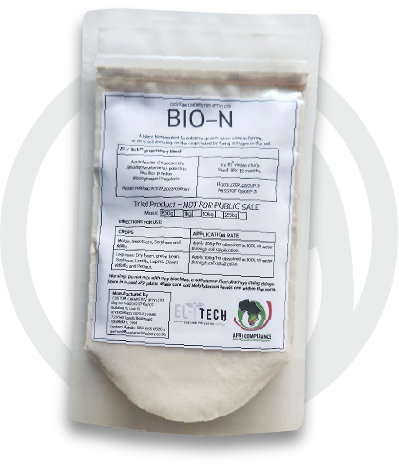

The patented Early Life Initiation Technology (ELI-Tech) fosters a symbiotic relationship between nitrogen-fixing bacteria, such as Azotobacter, and photosinthetic bacteria. This nitrogen fixation delivers the equivalent of 80N, though this may vary based on soil type. In sandy soils, where chemical fertiliser tends to wash away more quickly, Bio-N remains active and can provide nitrogen equivalent to 100N. The N values provided are a conservative estimate, based on comparisons between Bio-N results and those obtained using chemical fertilisers.
Bio-N can substitute or supplement chemical fertiliser and can be applied alongside it. For tree crops, it's advisable to supplement with chemical nitrogen fertiliser, as fertiliser costs are relatively low compared to row crops. With row crops, Bio-N can replace fertiliser either partially or entirely. The symbiotic process begins to take effect after two weeks and reaches its peak at approximately six weeks, with nitrogen levels starting to decline after eight weeks. This steady nitrogen release promotes stronger, healthier plants and leads to higher crop yields. The gradual release of nitrogen also mitigates the negative effects of excessive chemical nitrogen, such as issues like oranges failing to develop proper colour." It is important to reiterate, that the organic product consists of living organisms that can be killed by pesticides.
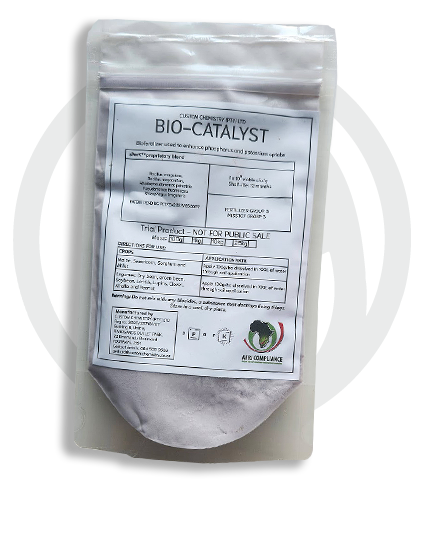
This product enhances the phosphorus and potassium uptake of plants up to 500%. It incorporates a mixture of bacteria patented as sParK, which solubilises the nutrients already present in the soil into a form that can easily be absorbed by plant roots. The technology also incorporates photosynthetic bacteria that provide food for the solubilising bacteria to function effectively. As a result, plants grow stronger with less chemical PK fertiliser than previously required. Key PK solubilising organisms include Pseudomonas fluorescens, Bacillus coagulans, and Bacillus megaterium.
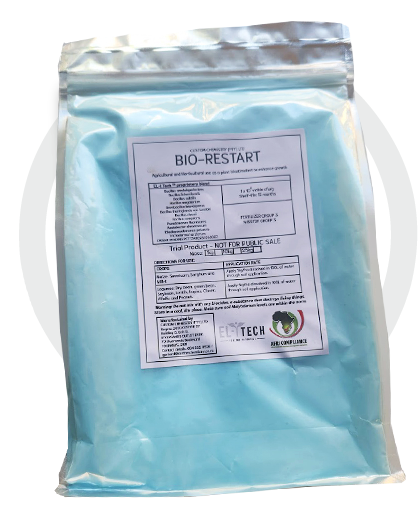
Bio-Restart combines the benefits of Bio-N, Bio-Catalyst, TerraFolia, and TerraFortis into a single solution for promoting vigorous plant growth and protecting root systems. TerraFolia safeguards against root rot, while TerraFortis offers protection against nematodes, such as eelworm.
Pesticides Range
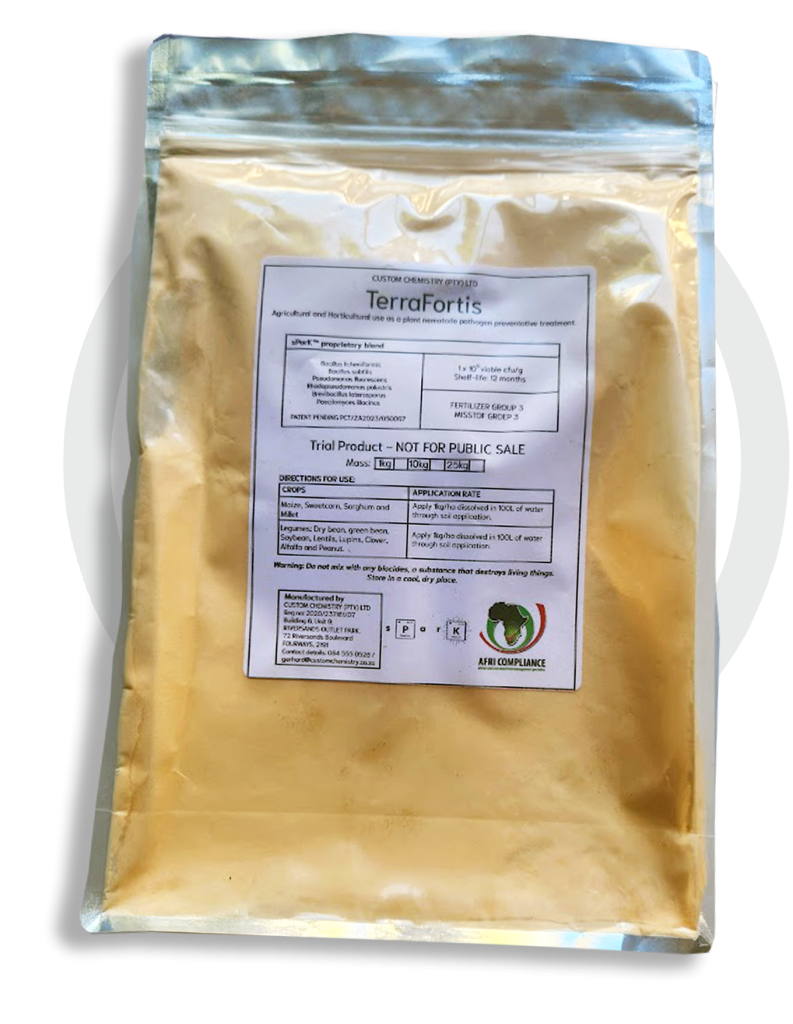

This product incorporates sParK technology alongside nematode-suppressing organisms that protect the plant's root system. The patented sParK technology increases the effectiveness of these organisms. Nematodes are microscopic soil-dwelling organisms that can cause significant crop damage, leading to financial loss. Chemical nematicides are expensive and raise environmental concerns, making TerraFortis an eco-friendly alternative. Effective biocontrolling agents include Bacillus subtilis, Brevibacillus laterosporus, and Pseudomonas fluorescens, which create a symbiotic layer in the rhizosphere around the plant's roots, repelling and killing nematodes. The product is 100% probiotic and non-pathogenic to both plants and humans.
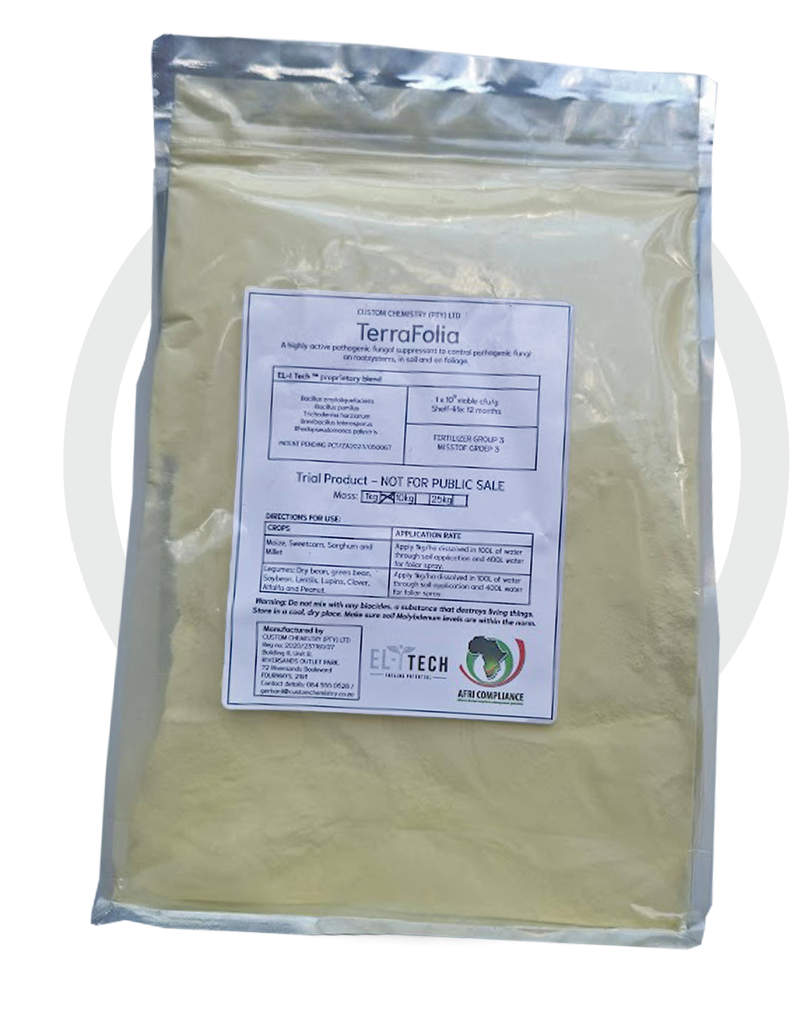
Fungal pathogens pose a significant threat to agricultural production, causing major losses every year. TerraFolia offers an organic solution at a competitive price against root rot, mould and other fungal deceases. The patented ELI-Tech increases the effectiveness of the biological agents, making it a viable substitute for chemical fungicides. Biological agents in TerraFolia include Bacillus amyloliquefaciens, Bacillus pumilus, Brevibacillus laterosporus, and Trichoderma harzianum. These are effective against pathogens like Rhizoctonia, Phytophthora, Pythium, Fusarium, Botrytis cinerea, and Sclerotinia Sclerotium.
Chemical insecticides are not only costly but also harmful to both the environment and human health, and they are becoming less effective as insects develop resistance. In contrast, biological insecticides have demonstrated excellent results, particularly in areas where chemical alternatives have lost their effectiveness. TerraVigor employs a combination of four powerful bacteria, each targeting different insect groups. Below is a table illustrating the specific bacteria and the insect groups they effectively eliminate:
| INSECTICIDE BACTERIA | TARGET GROUP |
|---|---|
| Metarhizium Anisopliae | Soil Dwelling Insects: Root Weevils, White Grubs, Termites |
| Beauveria Bassiana | Aphids, Whiteflies, Thrips |
| Bacillus Thuringiensis | Lepidopteran Larvae (Caterpillars) Mosquito Larvae |
| Brevibacillus Laterosporus | Mosquito Larvae, Corn Borers, White Grubs |